

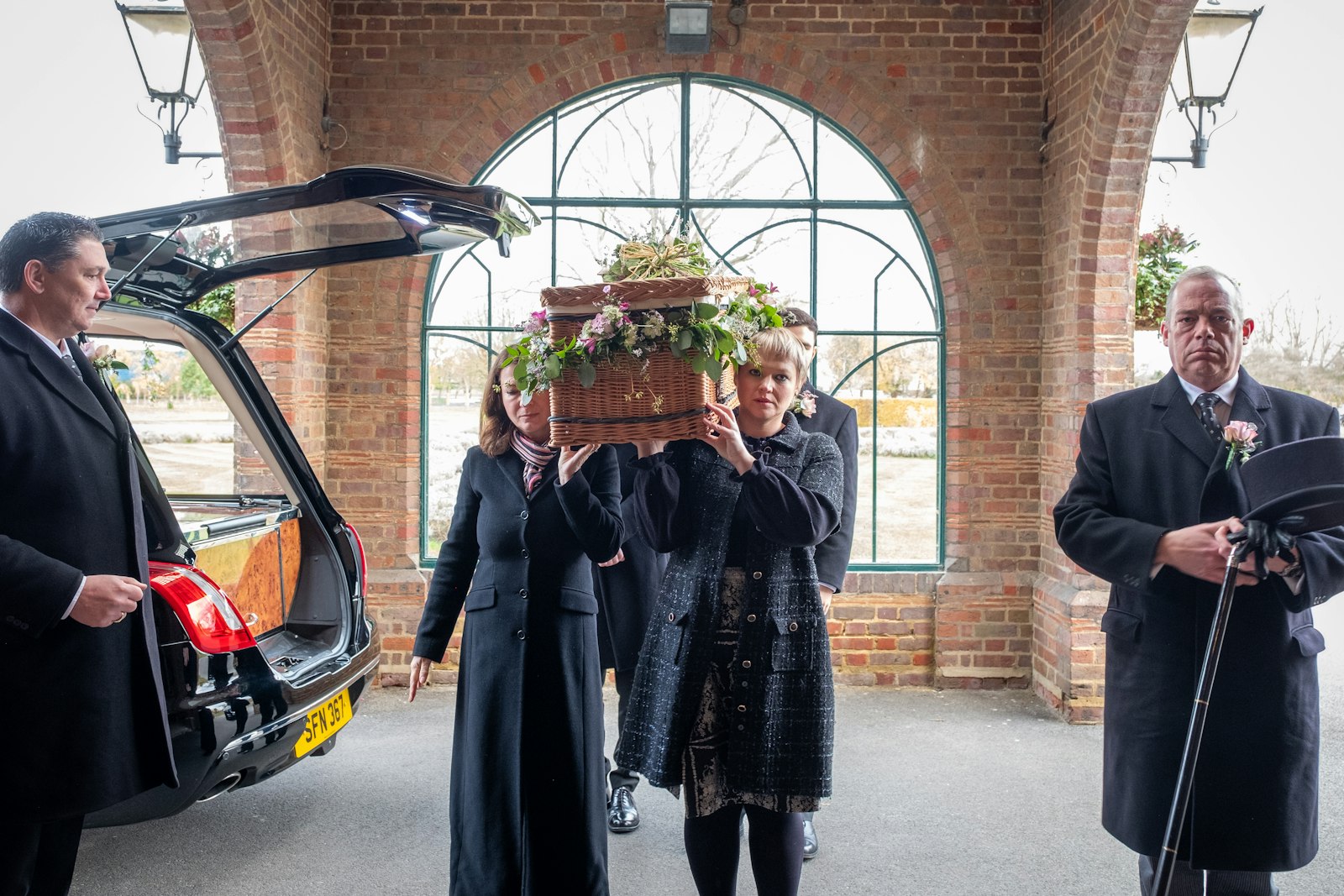
Writing a heartfelt eulogy for a husband may be the hardest thing anyone has ever asked of you. You built a life with him. You know him better than anyone in the room. And now you are expected to compress all of that into a few minutes of speech, while grieving, while exhausted, while everyone watches. That is an impossible ask. This guide will help you do it anyway.
You do not need to be a writer. You need honesty, a simple plan, and the courage to choose specific memories over sweeping statements. Everything else is just putting one word after another until the speech is done.
What Makes a Husband Eulogy Feel Heartfelt
A eulogy feels heartfelt when it sounds like someone who actually knew him. Not "a devoted husband and father." Not a list of his best qualities. The way he cleared his throat before bad news. The chair he always sat in. The thing he said every single time he walked through the front door.
Here is the thing: everyone in the room already loved him. They are not waiting for a summary. They are waiting for the version of him only you got to see — the private him, the domestic him, the one who existed inside the marriage.
The three elements to include
Almost every strong eulogy for a husband rests on three pieces:
- How you saw him — in a specific, ordinary moment nobody else witnessed
- Who he was to others — your kids, his friends, the people whose lives he shaped
- What he leaves with you — shown through what he taught, not stated as a moral
Those three carry most of the weight. Everything else is connecting tissue.
How to Start a Eulogy for Your Husband
Do not open with "we are gathered here today." Open with him. A gesture, a phrase, an image that puts him in the room immediately.
Try something like:
- "My husband Tom could not pass a hardware store without going in. We have been married thirty-two years and we own forty-seven screwdrivers."
- "The way I always knew David was home was the sound of him whistling in the garage. I have been listening for that sound for two weeks."
- "I want to start with a phone call, because my husband answered the phone in a way that told you everything about him."
These openings work because they are specific and unmistakably his.
A sample opening you can adapt
My husband Paul had a greeting he used for thirty-four years, every single time he walked in the door: "honey, I'm home — and I brought the news." He never brought the news. He just thought it was funny. And for thirty-four years, I laughed, because it was funny, because he was funny, because the sound of that line meant my person was home. I want to talk today about the man behind that greeting, because our kitchen is quieter now, and I do not want any of us to forget what he sounded like.
Choosing Memories That Actually Land
You have decades of memories to draw from. The hard part is picking. Specific, small moments will always beat a highlight reel of big events.
You might be wondering which memories to choose. Answer these quickly, without editing:
- What is a small, ordinary morning or evening with him that keeps coming back to me?
- What did he do that made me feel known?
- What is a phrase of his I can still hear in my head?
- What did he teach me, without trying to teach me?
- What is a moment with him and our kids (or grandkids) that I want the room to see?
Pick two or three. Expand them into short scenes. Keep the detail concrete.
Sample memory passage
Every Saturday morning for thirty years, Paul made pancakes. He was not a good cook. He burned at least one pancake every single time. He would eat the burnt one himself and pretend he preferred it, because he knew the kids wanted the good ones. That was his whole approach to being a father — quietly take the burnt piece, let the kids have the golden one, and never announce that you are doing it.
Expressing Love and Gratitude Without Slipping Into Clichés
"He was the love of my life" might be true, but it has been said at so many services that the phrase stops landing. Show the love. Do not announce it.
Instead of: "He was my best friend." Try: "Every night for thirty years, right before we fell asleep, he would reach over and squeeze my hand twice. That was his goodnight. I never needed a word for it."
Instead of: "He was a family man." Try: "He coached every one of our kids' teams, even the sports he did not understand. He learned soccer rules off YouTube on the drive to the first practice."
The good news? You already know the specifics. You have decades of them. You just have to trust that the small ones are worth saying out loud.
Simple phrases that carry weight
These plain phrases land well in a heartfelt husband eulogy:
- "What I learned from him was..."
- "He was the kind of man who..."
- "I will miss..."
- "If you knew him, you knew..."
- "Thank you for..."
Say less. Mean it. The shortest line in the eulogy is often the one the room remembers longest.
A Simple Five-Part Structure
A eulogy for a spouse usually earns a little more time than most. This five-part shape works well:
- Opening (30–45 seconds): Put him in the room with one concrete image or phrase.
- How we met / who he was to me (1 minute): A short origin story tied to a trait.
- Who he was to others (1 minute): Father, friend, colleague — with one specific detail per role.
- A specific story (1–2 minutes): One memory told in detail, with dialogue if you can remember any.
- What he leaves behind (45–60 seconds): What you carry forward. A direct thank-you. A goodbye.
Four to six minutes total. That is enough.
A Full Sample Heartfelt Eulogy for a Husband
Here is a complete example. Swap in your husband's details.
I met my husband Michael at a wedding in 1985. I did not know anyone there. He walked over, introduced himself, and said, "I saw you across the room and decided I was going to come talk to you before someone else did." Then he got very red in the face, because he had not meant to say it quite that directly. That was my first glimpse of him — brave, a little embarrassed, and completely himself. It was also, honestly, most of what I needed to know.
Michael was an engineer for thirty-eight years. He designed bridges. He loved bridges the way some people love music — he would pull over on road trips to look at a particularly good one. Our kids have hundreds of photos of Dad standing under bridges, grinning, pointing at load-bearing joints.
He was an even better father than he was an engineer, and he was a very good engineer. Our kids — Anna, Jack, and Lily — grew up in a house where homework was a team sport, dinners were loud, and Dad always, always knew how to fix whatever was broken. He taught Jack to drive in an empty parking lot on a Sunday and never once raised his voice, even when Jack hit the one tree in the whole lot.
The last thing Michael said to me, the night before he died, was "we had a good run, didn't we." We did. Thirty-eight years of the best possible run.
Michael, thank you for walking across the room in 1985. Thank you for the burnt pancakes and the parking-lot driving lessons and every bridge on every road trip. Thank you for squeezing my hand twice every night. I will miss you every day of my life, and I will try to be the person you saw across the room.
Delivering the Eulogy on the Day
Writing it is half the work. Reading it without falling apart is the other half.
- Print it in 14-point font, double-spaced. Mark your pauses with a slash.
- Keep water and a tissue on the podium. A sip buys you ten quiet seconds.
- Find a friendly face — often an adult child or close friend — and look at them when it gets heavy.
- Pause when tears come. The room will wait. Silence is not failure.
- Hand a backup copy to someone in the front row who can finish if you cannot.
Most spouses make it through. Many stop, cry, breathe, and keep going. Both are fine. The room is already on your side.
What If the Marriage Was Complicated?
Long marriages are not fairy tales. They have hard seasons, mistakes, silences, things that were never fully resolved. That does not disqualify you from giving a heartfelt eulogy.
The rule is this: write about what was true and good, and leave the rest out. You are not lying by choosing what to emphasize. A eulogy is a farewell, not a full record. One honest line — "we had our hard chapters, and I am grateful we had time to find our way back to each other" — is enough to acknowledge the complication. Then return to what you want the room to remember.
Frequently Asked Questions
How long should a eulogy for a husband be?
Four to six minutes spoken is a good target, or around 700 to 1,000 words. You have earned a little more room than most speakers, but the room still needs focus. Two or three real stories are enough.
Is it okay to break down while speaking?
Yes. You just lost your husband. No one expects composure. Pause, breathe, sip water, and keep going. The whole room is quietly rooting for you to finish.
Should I talk about how we met?
Often, yes. A short how-we-met story grounds the eulogy in a real moment and says something specific about him. Keep it to two or three sentences, and tie it to a trait you want to honor.
What if I cannot finish the eulogy on the day?
Ask an adult child, sibling, or close friend to stand near you with a printed copy. Tell them ahead of time that if you step back, they should step up. Most spouses get through. If you do not, nobody will judge you for it.
Is it appropriate to include our kids or grandkids?
Yes. Describing him as a father or grandfather — through a specific detail rather than the title — is often the most moving part of the eulogy. Use their names if they are comfortable with it.
Related Reading
If you'd like more help, these may be useful:
You don't have to write this alone.
Answer a few simple questions about your loved one, and we'll craft a personalized eulogy that sounds like it came from you.
Start My Eulogy