

Hindu Eulogy for a Grandfather: Faith-Based Tribute Guide
Losing your grandfather is a particular kind of grief. He was the keeper of the family's history, the voice at the head of the table, the one who remembered the old stories and the old prayers. Now the family is looking to you to speak for him — and you have to do it in a way that honors both who he was and the faith he lived by.
Writing a Hindu eulogy for a grandfather is different from writing a secular tribute. You are not only describing a life — you are placing that life inside a tradition that sees death as one step in a long journey. This guide walks you through it, from choosing the right scripture to finding the right story, with sample passages you can adapt.
Understanding the Hindu View of Death
In Hinduism, death is not an ending. The soul — the atman — leaves the body and moves on, carrying the weight of its actions into the next life. Your grandfather's funeral is part of a sacred ritual called antyesti, the last sacrifice, which releases his soul toward moksha, liberation from the cycle of rebirth.
Here's why this matters for the eulogy: you are not saying goodbye forever. You are sending him forward with love and blessings. The tone should reflect that — sorrow, yes, but also peace. Grief held with faith.
How the Rites Shape What You Say
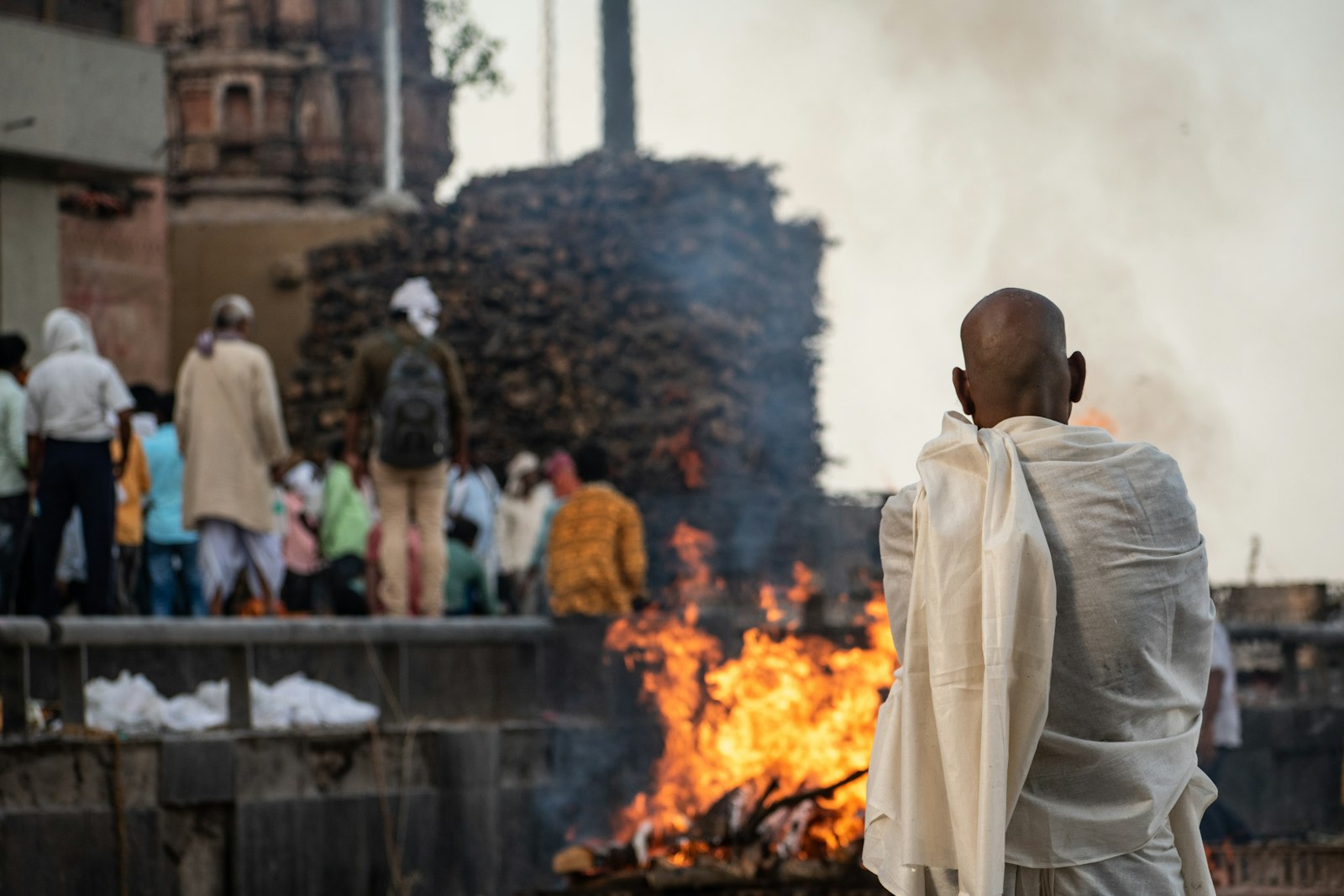
At a Hindu funeral, the priest chants Vedic mantras, the eldest son lights the pyre, and the family offers rice balls called pinda during the days that follow. The eulogy sits alongside these rites, not in place of them. Keep that in mind when you write.
A few practical points:
- The priest leads the religious portion. Your job is the personal one.
- Coordinate timing with whoever is officiating — often the eulogy fits just before the cremation or at the shraddha gathering later.
- If the family observes a thirteen-day mourning period, the shraddha on the thirteenth day is often where the fullest tribute is spoken.
What to Include in a Hindu Eulogy for a Grandfather
A strong tribute covers four areas: who he was, what he believed, what he did, and what he leaves behind. You don't need equal time for each — weight them toward the memories that feel most alive.
His Name, Lineage, and Role
Start by naming him properly. In many Hindu families, the grandfather is called dada (paternal) or nana (maternal). Use whichever the family used. Name his parents if you know them, his village or town of origin, and his place in the family.
This is not a formality. In Hindu tradition, a person's lineage is part of their identity, and naming it honors where he came from.
"My dada, Shri Ramesh Kumar Sharma, was born in 1938 in a small village outside Jaipur. He was the second son of Gopal and Lakshmi Sharma. He came to Delhi with nothing but a cloth bag and a head full of prayers his mother taught him. Everything our family has today started with that bag and those prayers."
His Faith and Practice
Many Hindu grandfathers lived their faith in small daily ways — the morning puja, the tulsi plant in the courtyard, the copy of the Ramayana by the bed. Name the specific things he did. Faith lived out in habit is more moving than faith described in abstract.
"Every morning before the sun was up, dada was at the shrine. A small brass lamp, a few marigolds, a bell, and the same set of shlokas he had recited since he was a boy. When I stayed at his house as a child, I woke up to the sound of that bell. I still hear it some mornings."
A Specific Memory or Two
One long, specific memory beats five general observations. Pick a scene. What was he wearing? What did he say? What did you learn? The goal is for the family to see him again for a minute.
"The summer I was eleven, I told dada I wanted to quit learning Sanskrit. It was too hard, the grammar made no sense, and none of my friends cared about it. He didn't argue. He walked me out to the garden, handed me a pair of pruning shears, and we cut back the jasmine for an hour without a word. Then he said, 'Some things you prune to make them grow. Other things, you leave alone.' I never quit Sanskrit."
His Blessings and Legacy
Close by naming what he leaves you. Not money — values. The way he greeted guests. The way he held his temper. The way he sat quietly with his tea before anyone else was awake. These are his real inheritance.
Scripture and Prayers You Can Use
Quoting from Hindu scripture gives the tribute weight and roots it in tradition. A light hand works best. One or two lines, then a plain-English reflection on why those lines fit him.
Bhagavad Gita 2.22
This is the most common verse at Hindu funerals:
"Vasamsi jirnani yatha vihaya, navani grhnati naro 'parani..."
"As a person puts on new garments, giving up old ones, the soul accepts new material bodies, giving up the old and useless ones."
You might follow it with: "Dada believed this. He was not afraid of this day. He told me once, 'The body is a shirt. The soul is the one wearing it.' That is the faith he is walking in now."
The Gayatri Mantra
Some families open the eulogy with the Gayatri Mantra, especially if the grandfather recited it daily. A simple approach: "Dada said this prayer every morning of his adult life. It feels right to begin with his prayer."
A Line from the Upanishads
The Brihadaranyaka Upanishad offers: "Asato ma sadgamaya, tamaso ma jyotirgamaya, mrityor ma amritam gamaya." ("Lead me from the unreal to the real, from darkness to light, from death to immortality.") This prayer fits particularly well at the end of a eulogy.
Sample Hindu Eulogy Passages for a Grandfather
Here are three passages you can adapt. Each one covers a different tone — traditional, personal, and closing.
Opening: Traditional
"Om shanti, shanti, shanti. We gather today to honor the life of Shri Hari Prasad Iyer — father, husband, friend, and to five of us, the dada who shaped our childhoods. He lived eighty-seven years. He lived them the way his own father taught him: with faith, with discipline, and with a door that was always open."
Middle: Personal
"When I think about dada, I do not think about the big moments. I think about Sunday afternoons. He would sit on the veranda with his newspaper and a cup of strong, sweet chai. If you sat down next to him, he would pour you half of his cup — never a full new one, always half of his. I understand now what he was saying with that. Whatever I have, I share with you. That was how he lived."
Closing: Blessing
"Dada, we release you with love. Go forward on the path the atman travels. You leave us your prayers, your garden, your laugh, and your name. We will carry all of it. Om shanti, shanti, shanti."
Delivering the Eulogy
The good news? You do not have to be a trained speaker. You only have to be honest and prepared.
A few practical tips:
- Print it large. Size 16 font, double-spaced, on paper you can hold without rattling it.
- Read it aloud three times before the funeral. Where you stumble, simplify.
- Pause at the Sanskrit. Say each word slowly. If you are not confident, ask the priest to help you rehearse.
- Bring water. Keep a small glass nearby. It is fine to stop and drink.
- Have a backup. Ask one family member to be ready to take over if you cannot finish. No one will judge you.
If You Are Speaking in English and Sanskrit
Many families today speak both. When you quote a shloka, say it first in Sanskrit, then give the English meaning in plain words. Do not try to translate line by line in poetic English — it slows everything down and rarely sounds right. One Sanskrit line, one clear English sentence. That is enough.
What to Avoid
A few things to steer clear of:
- Do not dwell on suffering. Hindu tradition sees the body's release as a mercy. Focus on peace, not pain.
- Do not make it about you. Your grief matters, but the tribute is his.
- Do not exaggerate. If he had flaws, you do not have to list them, but do not rewrite him into a saint either. The real man is more moving than the ideal one.
- Do not run long. Five minutes spoken well is worth more than fifteen minutes rambled.
Frequently Asked Questions
What should you include in a Hindu eulogy for a grandfather?
Include his name, lineage, and role in the family. Speak about his values, his faith, and the lessons he leaves behind. A short Sanskrit shloka or a line from the Bhagavad Gita often opens or closes the tribute.
How long should a Hindu eulogy for a grandfather be?
Most families keep it between three and seven minutes, or roughly 500 to 900 words spoken slowly. At an antyesti ceremony, the priest leads the rites, so the family eulogy is usually brief. A longer tribute fits better at the shraddha gathering.
Can you quote the Bhagavad Gita in a grandfather's eulogy?
Yes. Chapter 2, verse 22 — on the soul changing bodies like worn garments — is often spoken at Hindu funerals. Quote one or two lines at most, then explain in your own words why it fits him.
Is it appropriate to include humor in a Hindu eulogy?
Gentle humor is welcome, especially warm memories that made the family laugh. Avoid anything that could feel disrespectful during the cremation rites. Save lighter stories for the shraddha or the thirteenth-day gathering.
Who usually gives the eulogy at a Hindu funeral?
Traditionally the eldest son or grandson speaks, though any close family member may. In many modern Hindu funerals, multiple grandchildren share short tributes. Coordinate with the priest so the eulogy fits between the rites.
Related Reading
If you'd like more help, these may be useful:
You don't have to write this alone.
Answer a few simple questions about your loved one, and we'll craft a personalized eulogy that sounds like it came from you.
Start My Eulogy