

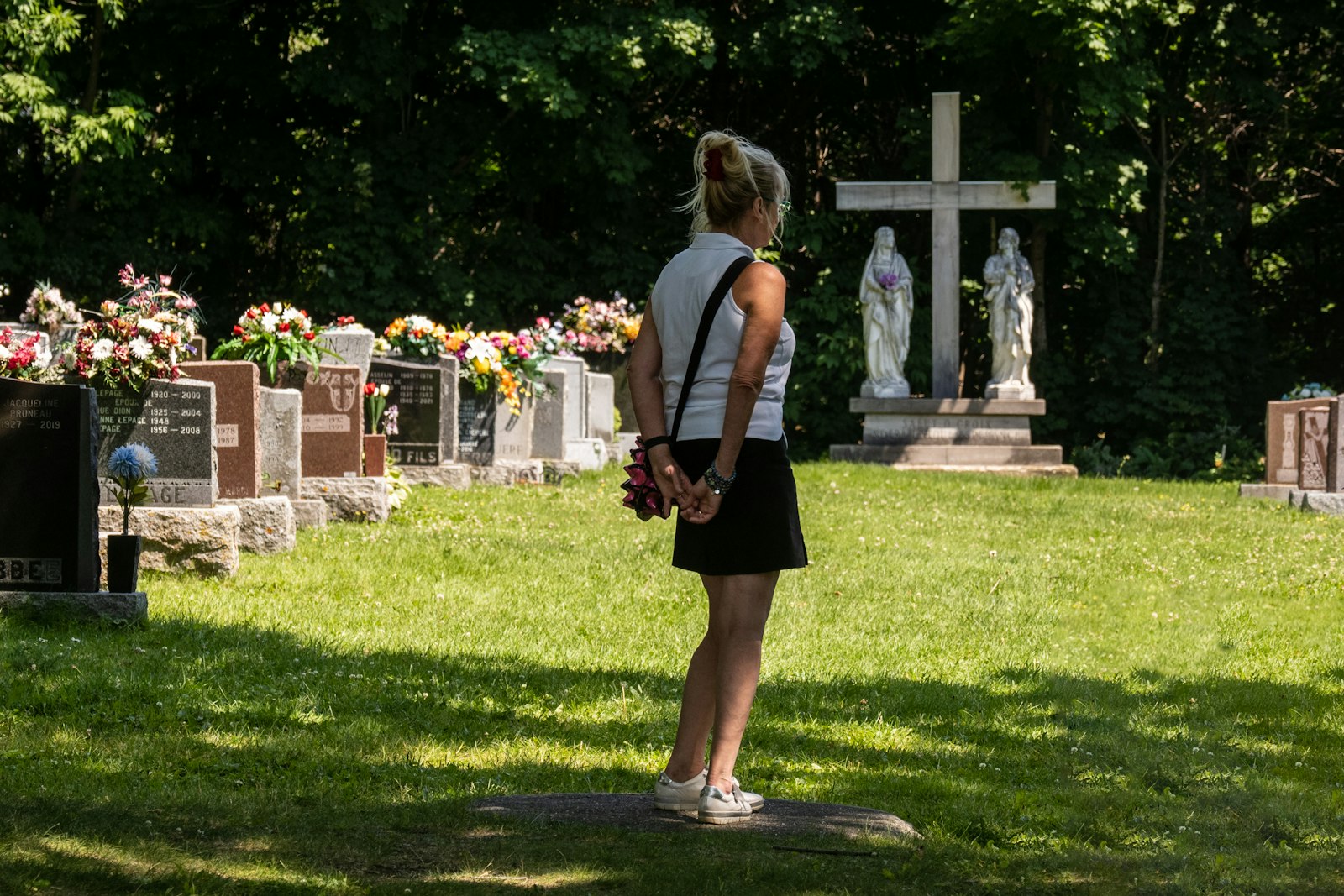
There is no harder speech than the one for your daughter. If you're writing a non-religious eulogy for a daughter — because she wasn't religious, or you aren't, or faith doesn't feel like the right language for this grief — you have a path that's just as powerful as any religious one. It's a path built out of memory, specificity, and love.
This guide will help you write a secular eulogy that sounds like her. You'll find structure, real example passages, secular phrasing, and the practical moves that keep a eulogy from drifting into vague sentiment. No clichés. Just the tools you need today.
Why a Secular Eulogy Can Feel Right
Not every family is religious. Not every daughter was. And even when the rest of the service leans spiritual, the eulogy is yours. It should sound like the person who's speaking and the person being remembered.
A secular eulogy doesn't pretend to know what happens next. It does something harder and more honest: it looks at her life, exactly as it was, and names what mattered about it.
Here's the thing: without scripture to fall back on, every sentence has to earn its place. That's not a disadvantage. It makes for a better eulogy — sharper, more personal, harder to forget.
What Belongs in a Non-Religious Daughter Eulogy
A strong secular eulogy is specific. It's about her, not about daughters in general.
Include: - Her full name and the way people actually called her - Her personality — the texture of her, not a resume - Two or three real scenes from her life - Her voice: things she said, jokes she told, opinions she held - What she loved and who she loved - What you'll carry from her - A closing that names the loss plainly
Leave out: - "She's in a better place" - "God needed her more" - Bible verses or prayers - Anything that softens her into someone easier to mourn
If a sentence feels like it could be said about anyone, rewrite it until it can only be said about her.
Structure: A Simple Five-Part Frame
You don't need anything fancy. Most secular eulogies follow the same basic shape.
1. Open
Name yourself. Thank people for being there. Keep it short.
"I'm Sarah's mother. Thank you all for coming. Looking around this room, I see thirty years of her life staring back at me — friends from kindergarten, her college roommate, the woman she worked with last summer. She collected people like other kids collect shells."
2. Paint Her
Give the room a picture. Not her achievements — her personality.
"Sarah was loud. I say that as a compliment. She laughed loud, argued loud, loved loud. She had opinions about everything — movies, grocery stores, the correct way to fold a towel. Being in a room with Sarah meant you knew where you stood, and you knew she'd fight for you if it came to it."
3. Tell a Story
Pick one or two scenes. Real ones, with detail.
"The summer she was twenty-three, she drove across four states in an unreliable Honda to bring me soup when I had pneumonia. She stayed for a week. She reorganized my entire kitchen, which I did not ask for. When she left, she'd labeled every drawer in the house with a label maker she brought with her. I still have the labels. I can't bring myself to peel them off."
4. Name What She Gave You
This is the heart of a secular eulogy. Religion offers an afterlife; you offer the gift she left behind.
"She taught me that kindness can be stubborn. That you can be the loudest person in the room and still listen. That some people are worth driving four states for. These aren't things I believed before her. They're things she made me believe by being herself."
5. Say Goodbye
Plainly. Without flinching.
"I don't have a tidy ending. She was my daughter and now she isn't anywhere I can reach her. What I have is thirty years of her, and everyone in this room carrying a piece. That's where she is now. That's where she stays."
Secular Phrases That Work
When you strip out religious language, you need other ways to carry the weight. These phrases do it without sounding hollow.
- "She lives on in the people who loved her."
- "We carry her with us."
- "Her story continues in everyone she touched."
- "Love doesn't end. It just changes how it's held."
- "She is gone, and she is not forgotten."
- "The world was different because she was in it."
- "We don't say goodbye. We say 'I'll keep you with me.'"
You can also pull from secular poetry — Mary Oliver, Raymond Carver, Maya Angelou, Wendell Berry. A short verse from a poem she loved can do more than a paragraph of your own words.
Three Example Passages
Use these as shape, not script. Every daughter deserves her own.
Example 1: For an Adult Daughter
"Rachel was thirty-four. She hated being photographed, so we have fewer pictures than I'd like. But I don't need them. I remember her exactly — the way she sat on the floor when she was thinking, the way she always left her shoes by the front door in a perfect line, the way she said 'love you, bye' as one word when she hung up the phone. Those are my photographs."
Example 2: For a Young Daughter
"Ellie was eleven. She wanted to be a marine biologist, then a chef, then a marine biologist again. She kept a notebook where she drew every dog she met. She named the spiders in the garage instead of killing them. Eleven years is not enough, and I won't pretend it is. But those eleven years were full — of her, of us, of everything she was becoming."
Example 3: For a Grown Daughter Lost Too Soon
"Maya was twenty-seven. She had just signed a lease on an apartment she was excited about. She had plans — so many plans. I keep wanting to tell her the things I meant to tell her. Instead, I'll tell you: she was funny in a way you had to pay attention to catch. She was fiercely loyal. She was mine, and she was hers, and she was more herself every year."
But there's a catch: don't copy the sentence rhythms. Write hers the way she'd want to be written.
Mistakes to Avoid
A few things commonly trip up secular eulogies.
Over-defending the secular choice. You don't owe the room an explanation. Skip the disclaimer and just speak.
Drifting into abstraction. "She had a beautiful spirit" means almost nothing. "She kept a list of every book she'd read since age twelve" means her.
Being afraid of silence. A pause after a heavy sentence is not a failure. It lets the room feel the weight.
Trying to explain her death. You don't have to. Secular eulogies are about her life.
Frequently Asked Questions
How do you write a non-religious eulogy for a daughter?
Center the eulogy on who she was — her personality, her interests, the people she loved. Use specific memories rather than general statements. Replace religious language with secular phrases that honor the love without invoking an afterlife.
What do you say at a secular funeral instead of a prayer?
You can read a poem, play a song she loved, or ask people to share a short memory. A moment of silence also works — it lets everyone hold her in mind without any scripted words.
Can a non-religious eulogy still be spiritual?
Yes. Many secular eulogies talk about connection, meaning, memory, and love in ways that feel deeply spiritual. The distinction isn't about depth — it's about not invoking a specific religious framework.
How long should a non-religious eulogy for a daughter be?
Aim for five to ten minutes spoken aloud, or roughly 750 to 1,500 words. That's long enough to tell real stories and short enough to get through without losing your voice.
Is it okay to read from notes?
Yes. Read from notes. Hold the paper. Nobody expects you to speak this from memory. What matters is that you say it.
Related Reading
If you'd like more help, these may be useful:
You don't have to write this alone.
Answer a few simple questions about your loved one, and we'll craft a personalized eulogy that sounds like it came from you.
Start My Eulogy