

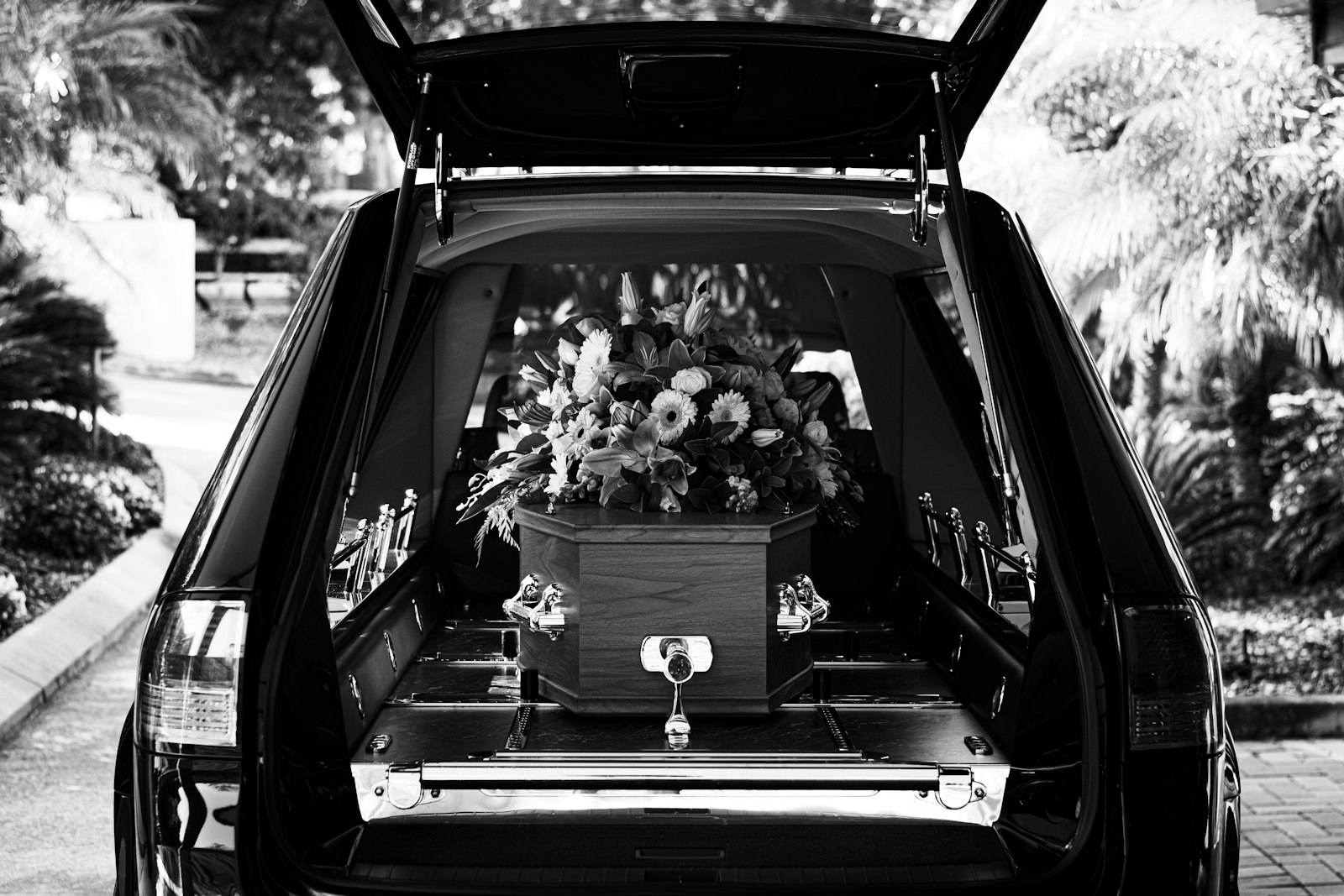
If your wife did not hold a faith — or if you do not — a non-religious eulogy for a wife is the honest way to say goodbye. A secular tribute keeps the focus on the woman you married: her humor, her work, the home you built, the way she moved through a room. You do not need prayer or Scripture to make her sendoff mean something.
This guide walks you through writing one that sounds like her and sounds like your life together. You will find sample openings, secular readings, alternatives to common religious phrases, a full sample eulogy you can adapt, and answers to the questions most widowers and widows have when they sit down with a blank page.
What a Non-Religious Eulogy Is
A secular eulogy skips God-talk and afterlife references. That is the only rule. Everything else — love, grief, humor, specific memories — stays.
Here's the thing: non-religious does not mean distant. A humanist tribute to a wife is often the most intimate thing said at the service, because it stays with the woman you actually knew. You are not borrowing meaning from a tradition. You are telling the truth about her.
What you leave out
- Prayer, hymns, Scripture
- "She's with God now" or "she is in heaven"
- Assumptions that the room shares a faith
- "Rest in peace" — optional, many secular families keep it
What you keep
- Real stories in your own voice
- Humor, if she had any
- Specifics — her perfume, her coffee order, the way she said your name
- The weight of losing her, said plainly
Open With Her, Not With the Loss
A strong eulogy for a wife begins with her in the room. Skip the formal opening. Start with one image, one line, one habit that only fits her.
Try something like:
"My wife Rachel had two speeds: full commitment or complete indifference. There was no in-between. If she was reading your email, she would answer it in three minutes. If she wasn't, it was gone forever."
"Lisa always said she did not believe in clutter, and then she lived in a house with four thousand books. That was her in one sentence — principled, unpersuadable, funny about it."
"The first thing people noticed about Maya was her laugh. The second thing was that she was already on to the next joke."
Each one puts her in the room before the sorrow does. That is the opening you want.
Secular Readings for a Wife
A short reading gives the service a pause without reaching for religion. Good options:
- "Late Fragment" by Raymond Carver — four lines on being loved, perfect for a close
- Sonnet XVII by Pablo Neruda ("I do not love you as if you were salt-rose…") — intimate, entirely secular
- "When Death Comes" by Mary Oliver — on living fully, no afterlife
- "Funeral Blues" by W.H. Auden — written for the loss of a partner
- "Do Not Stand at My Grave and Weep" by Mary Elizabeth Frye — soft, not religious
- Song lyrics — your wedding song, a first-dance song, or anything by Leonard Cohen, Joni Mitchell, or Nick Cave
If she was a writer herself, a paragraph from one of her journals is worth more than any poem. A line from a card she once wrote you is even better.
Alternatives to Common Religious Phrases
People default to religious language at funerals because it is easy. If you want to stay secular, swap each phrase for something concrete.
| Religious phrase | Secular alternative |
|---|---|
| "She's in a better place" | "She lived the life she wanted" |
| "God called her home" | "We lost her too soon" |
| "She's an angel now" | "She is in everyone who loved her" |
| "Rest in peace" | "Goodbye, my love" or just her name |
| "Gone but not forgotten" | "She is not finished with us" |
| "Till we meet again" | "Until I can tell this story without crying" |
The good news? You do not have to fill the silence at all. A eulogy can end on her name and nothing else.
Structure for a Wife's Eulogy
A non-religious eulogy for a wife runs seven to ten minutes — a little longer than for other family members, because the spouse is often the last speaker and carrying the shape of the whole marriage. Here is a frame that works.
- Opening (45-60 seconds). An image or line that is only her.
- Who she was (2 minutes). Her personality, her work, what she cared about.
- Your life together (2-3 minutes). How you met, what you built, what she made of you.
- One specific story (2-3 minutes). A memory told in full, with details.
- What she leaves behind (60-90 seconds). Children, friends, the habits she passed on.
- Closing (30-45 seconds). The line you want the room to keep.
You might be wondering whether to mention her illness or cause of death. Briefly, if it defined her last years. Otherwise, spend the eulogy on her life, not her last months.
The marriage is the frame, not the subject
It is tempting to make a eulogy for a wife into a eulogy for the marriage. Resist that. The room is there for her. Tell stories that show her — and let the love come through in how you tell them. If you do it right, they will understand the marriage without you saying a word about it.
A Full Sample Non-Religious Eulogy for a Wife
Use this as scaffolding. Swap in your wife's name, her details, your story. The shape holds.
My wife Caroline believed, to the very end, that the correct answer to "how was your day" was never "fine." She would either tell you the whole day, in order, with the names of everyone she had spoken to, or she would say, "ask me a better question." There was no shortcut with her. I spent twenty-nine years being asked better questions.
She was sixty-one when she died. We met in our twenties at a party neither of us wanted to go to. She had a beer in one hand and a dog-eared copy of a Joan Didion essay in the other. I asked her what she was reading. She said, "something you wouldn't like," which turned out to be the first of many things she was right about.
Here is what I want you to know about her. She was principled in a way that was occasionally exhausting and always worth it. She worked forty-one years as a public defender, and she never once pretended that the job was getting easier. She came home furious some nights. She came home laughing on others. She came home. That is the thing I will miss most — the sound of her keys, the sigh at the door, the "you will not believe what happened today."
The story I keep coming back to is from our third year of marriage. I had taken a job I hated for money we needed, and I was miserable, and I would not admit it. She let me be miserable for about two months. Then one night she put a plate of spaghetti in front of me and said, "You are going to quit tomorrow. I already looked at the numbers. We will be fine." We were fine. I quit. That was my wife — pragmatic, brave for both of us, never one to let me lie to myself for longer than was useful.
She was a mother. She raised two kids who are sitting in the front row and who are the two people in this world I am most proud of, and every good thing about them is something she taught them. She was a daughter. She was a sister. She was a friend to so many of you here today, which is why you came.
I do not know where Caroline is now. I do not think she is anywhere. But I know she is in my hands, which have cooked her recipes so many times they do not need the book anymore. I know she is in our daughter's laugh, which is identical to hers. I know she is in the way our son argues — patiently, and until he wins. I know she is in this room.
Caroline, twenty-nine years was not enough. It was never going to be enough. But you were the great luck of my life, and you loved me so well, and the world was better because you were in it.
Goodbye, my love.
That is roughly 550 words — about four and a half minutes spoken. Add one more story or a reading to hit the full seven to ten minutes.
If You Hit a Wall
Writing about a wife who just died is one of the hardest writing tasks there is. If you sit down and nothing comes, try one of these:
- Write her a letter. Start with "Caroline, I keep thinking about…" You can strip the greeting later.
- Ask one person for one story. A close friend of hers, a sibling, a grown child. An outside memory often unlocks your own.
- Open your phone. Your last texts, photos, the voicemails you saved. The details you forgot are there.
- Set a ten-minute timer. Write whatever comes. Fix it later.
But there's a catch. Do not wait for the perfect opening. Write a bad one and replace it. Most eulogies get written in the second draft.
Delivering It
Read the eulogy out loud at least twice before the service. Once alone. Once to a child, a sibling, or a close friend who knew her. Mark the lines where you might break — her name, the shared memory, the closing. You are allowed to cry. Have water. Have a printed copy in a folder. Have someone in the front row you can look at. If you lose a line, pause, breathe, and start the next sentence. The room is with you.
You don't have to write this alone.
Answer a few simple questions about your loved one, and we'll craft a personalized eulogy that sounds like it came from you.
Start My Eulogy